
Radiation Protection and Monitoring
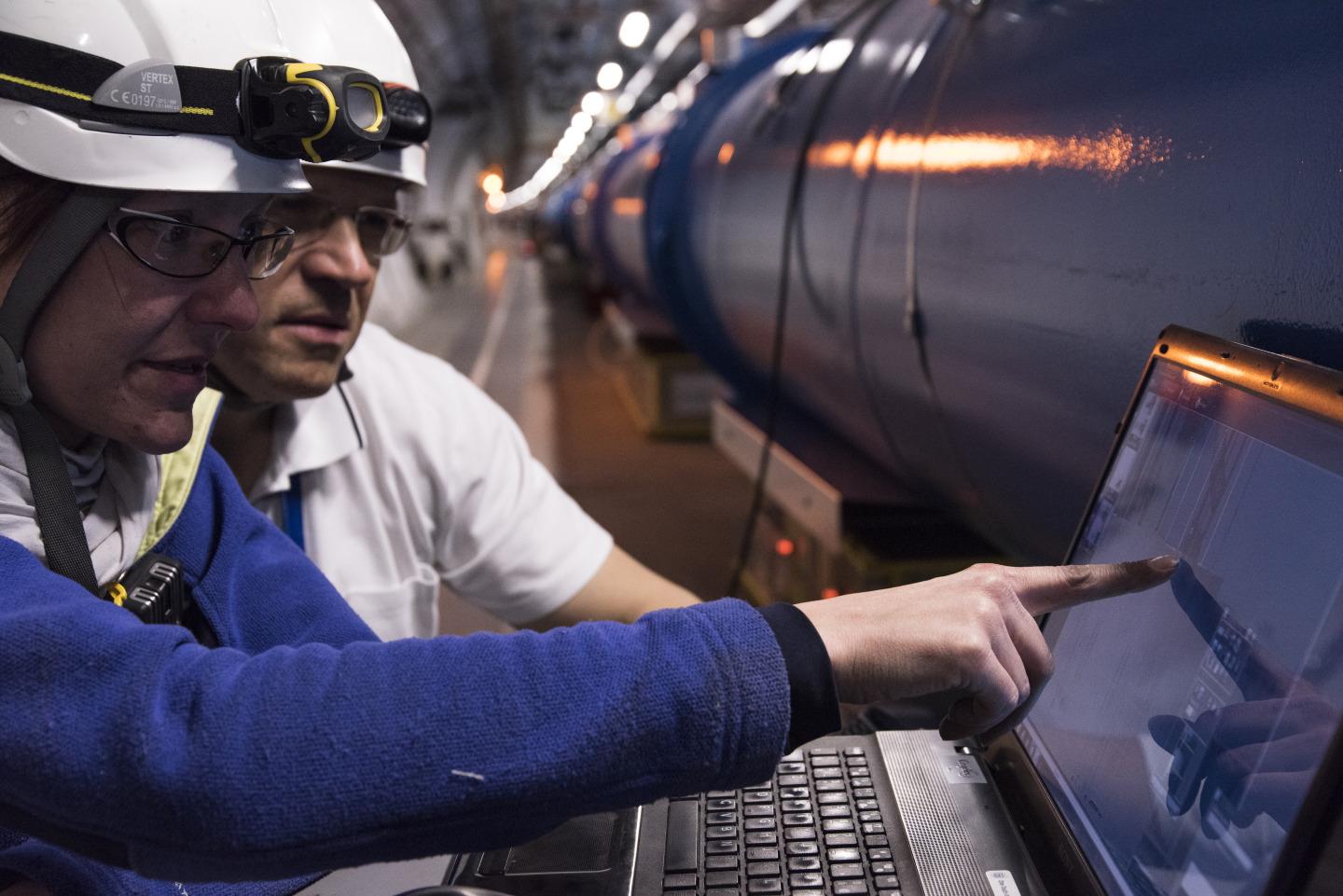
CERN’s unique know-how derived from years of designing, installing and operating systems to monitor level of radiations.
CERN’s Know-How
- High level of radiation across LHC equipment, experiments requiring high level of security and safety
- Development and operation of radiation monitoring systems, designed to operate in high magnetic fields
- Vast experience with simulation, testing and qualification of the impact of radiation on materials and electronic devices
Facts & Figures
- 11000: number of personal dosimeters
- 100 M: measurements per day
- 4 T: magnetic field tolerant
- 50 km: of radiation areas
Key Competencies
High-energy reference field
The CERN-EU high-energy Reference Field (CERF) facility, in the SPS North Experimental Area, is a workplace radiation facility providing reference neutron fields for testing, intercomparing and calibrating passive dosimeters and active instruments used at particle accelerators, on-board aircrafts and in space.
Calibration laboratory
The CERN radiation protection laboratory (CALLAB) is a state-of-the- art calibration facility designed according to the requirements of ISO 17025 standard. CALLAB consists of two irradiation rooms (named CC60 and main calibration hall, respectively), office space, storage and control rooms.
Key Applications
Simulation software for radioactive materials
Simulation software used to evaluate activation levels of radioactive materials and reduce the cost and time necessary to manage nuclear waste while fulfilling safety and regulatory requirements. Allows to decide on materials to use, based on their the activation potential.
SCADA system for measuring radiation impact
REMUS is a Supervision, Control and Data Acquisition system (SCADA), able to monitor and control organisations’ impact on their environment. REMUS took advantage of more than 30 years of experience providing safety systems to CERN.
Portable radiation survey meter
When close to a magnetic field, existing radiation survey meters have difficulties delivering reliable radiation measures. This can be a safety hazard for radiation measurements to assess threats. This portable B-RAD device is designed to accurately measure radiation despite the presence of magnetic fields. It is commercially available.
Radon Dose Monitor (RaDoM)
RaDoM is a radon monitor device that provides both a measurement of the radon concentration in air, and adirect estimate of the effective dose. RaDoM has the purpose of monitoring the radon gas, that is currently the second cause of lung cancer deaths, after smoking. Radon is a radioactive, colourless and odourless gas that poses a risk to health when it accumulates in buildings.
Robust, long distance sensors
Radiation, temperature, humidity and strain sensors are important to monitor challenging environments, such as those in the LHC. Conventional fibre optic systems are discretely distributed and not radiation hard. CERN’s distributed optical fibre know-how can help create cost-effective, long distance, robust monitoring systems.
Radiation-hardened components for highly reliable space missions
Just like in spacecrafts, the devices inside accelerators and detectors must be able to withstand high levels of radiation. For this reason, CERN has designed and tested many radiation-hardened microelectronics, optoelectronics and detector components. Today, these technologies can have direct applications in space, from power distribution to data transmission and processing. CERN also investigates new fields: high efficiency gallium-nitride power transistors, as well as breakthrough silicon photonics solutions.
Apart from the well-known Timepix and other hybrid-pixel sensors, CERN explores new radiation-hardened detection technologies suitable for space applications. MAPS (Monolithic Active Pixel Sensors) sensors, like ALPIDE, as well as Gas Electron Multipliers are being considered for scientific space missions like China’s CSES-2, to study the impact of seismic events on the Earth’s magnetic fields, and NASA’s IXPE, to measure the polarisation of cosmic X-rays.
From power distribution to data transmission and data processing, many technologies developed at CERN are suitable for space applications:
- DC-DC converter modules (FEAST and bPOL systems);
- Optical transceivers (GigaBit Versatile Link and Versatile Link PLUS transceiver projects);
- General purpose FPGA-based radiation tolerant boards (GEFE, GBT Expandable Front-End).
Radiation-tolerant systems
Cheaper and better satellites? One of the most important features of the new-space ongoing revolution is the increasing adoption of standardised COTS (Commercial-Off-The-Shelf) components for space missions, especially for low- Earth orbit constellations. COTS components are indeed attractive thanks to their state-of-the-art performance, reduced cost, and high availability on the market. CERN can help increase the reliability of instruments based on COTS, by choosing the right components and optimising the system design.
CERN has vast experience in characterising components to design radiation tolerant systems. As such, it has developed one of the largest data-bases of test reports. An exceptional feature is its unique testing facilities, which are able to screen large batches of components and perform system-level testing.
Cameras, advanced radio systems, on-board computers… CERN works hand-in-hand with space companies and organisations to improve the radiation-tolerance of advanced space systems. One remarkable example is CNES’ Eye-Sat nanosatellite, launched in 2019. At the European level, CERN is coordinating the RADSAGA and RADNEXT projects, paving the way to standardised radiation-hardness assurance at system level.
Related Articles
Case Study
- CERN tech in space: the first CERN-driven satellite has been successfully launched
- CERN-tested optical fibres now on the International Space Station
- From CERN to Jupiter: Juice embarks on its historic journey
Projects
- A non-destructive laser application for quality control & radiation studies in semiconductor devices
- CELESTA
- Celesta – A CubeSat Demonstrator for RadMon and CHARM applications
- Characterisation of the Timepix4 for measurements in hospital theatres.
- Development of the FLUKA code for hadron therapy
- Distributed Optical Fibre Radiation & Temperature Sensor
- FastIC Read-out chips for High-energy Physics and Medical Technologies
- HTS Demonstrator Magnet for Space (HDMS)
- IGLUNA: Building a demonstrator moon habitat in Zermatt
- ION fragmentation for CHIMERA
Newa