
Einstein Telescope: CERN expands its collaboration
CERN and the Einstein Telescope Collaboration have signed a new engineering and safety agreement, advancing the project for a next-generation European gravitational-wave observatory
The discovery of gravitational waves by the LIGO/VIRGO collaboration in 2015 confirmed a century-old prediction by Einstein and opened up new perspectives on the Universe. While particle accelerators, such as the Large Hadron Collider (LHC), recreate high-energy conditions similar to those that prevailed in the early Universe in order to study particles and fundamental forces, gravitational wave detectors observe tiny ripples in space-time caused by astrophysical phenomena, such as black hole mergers. These two types of facilities offer complementary means of probing the Universe, and thus strengthen our knowledge at the microscopic and macroscopic scales.
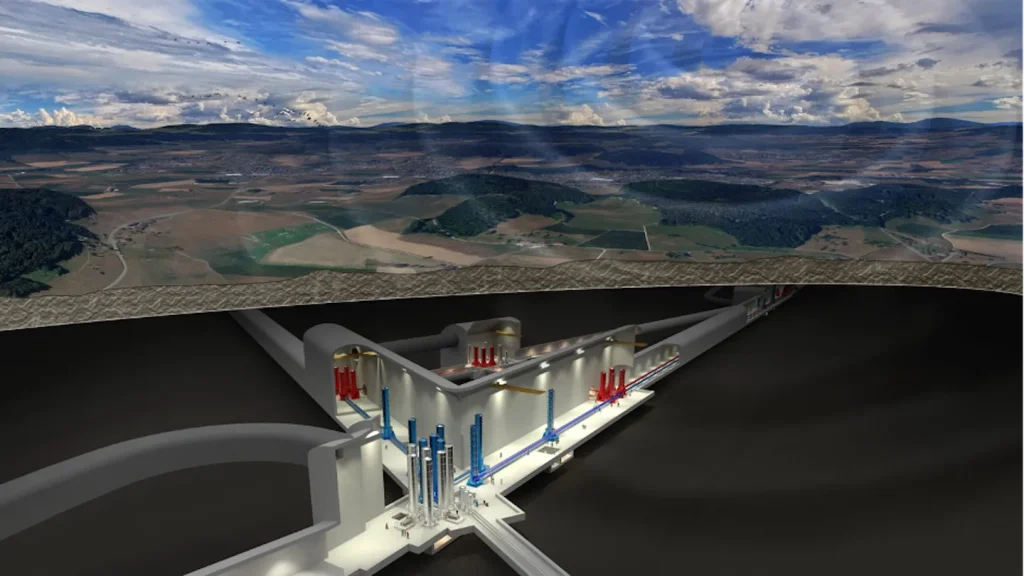
The Einstein Telescope (ET), a next-generation gravitational-wave detector currently under study, will be the most advanced gravitational-wave observatory in Europe. Located underground, it will detect gravitational waves by continuously monitoring the length of its huge sensing arms, using lasers and sensitive mirrors maintained in ultra-high vacuum conditions. The technologies essential to the design of the CERN-recognised Einstein Telescope overlap widely with those required for accelerator facilities, such as the LHC and future colliders.
The ET project is the subject of several collaboration agreements between CERN and the institutes leading the project (Nikhef in the Netherlands and INFN in Italy). The first agreement, signed in October 2022, covers the fields of vacuum, materials, industrial production and surface treatments. In September 2023, the ET project was the subject of an additional agreement with CERN in the field of civil engineering. In March 2025, a new agreement was signed to extend CERN’s collaboration to engineering and safety. In this context, CERN and other partners in the ET project will collaborate on the safety and engineering studies necessary for the development of a preliminary technical design report.
“This collaboration fits perfectly with CERN’s expertise, mission and ongoing studies on the Future Circular Collider (FCC), and is a unique opportunity to take advantage of important synergies in the field of underground infrastructure and large-scale safety systems,” says Jean-Philippe Tock of CERN’s Engineering Department. As the ET project and the FCC project will overlap directly in terms of the challenges to be overcome and the solutions to be developed, this collaboration will allow for a mutually beneficial exchange of knowledge, expertise and innovations.
CERN’s Engineering Department will support activities related to the Einstein Telescope in areas such as power distribution, cabling for signal transmission and installation of optical fibres, cooling and ventilation, access and security systems, configuration management, spatial integration, and project planning and coordination. Aspects related to the design of the technical infrastructure and security are closely linked. It is therefore quite relevant to combine these aspects in a single agreement.
“A facility as revolutionary as the Einstein Telescope requires innovative safety solutions that go beyond simply adjusting existing models,” says Saverio La Mendola of CERN’s HSE unit. The Occupational Health and Safety group’s expertise in designing safety systems for CERN’s current and future facilities will also be very valuable for the ET collaboration.
The location of the Einstein Telescope will be determined during the study phase, with the aim of ensuring that the facility is operational from 2035 and collecting physics data by 2040. Offering significantly higher sensitivity than the current gravitational-wave observatories LIGO and VIRGO, the Einstein Telescope will allow researchers to study the birth of black holes, the structure of neutron stars and the nature of the Universe just after the Big Bang. By providing expertise in many fields, CERN will help make this promising scientific future a reality.
This post was originally published on the CERN home page.